


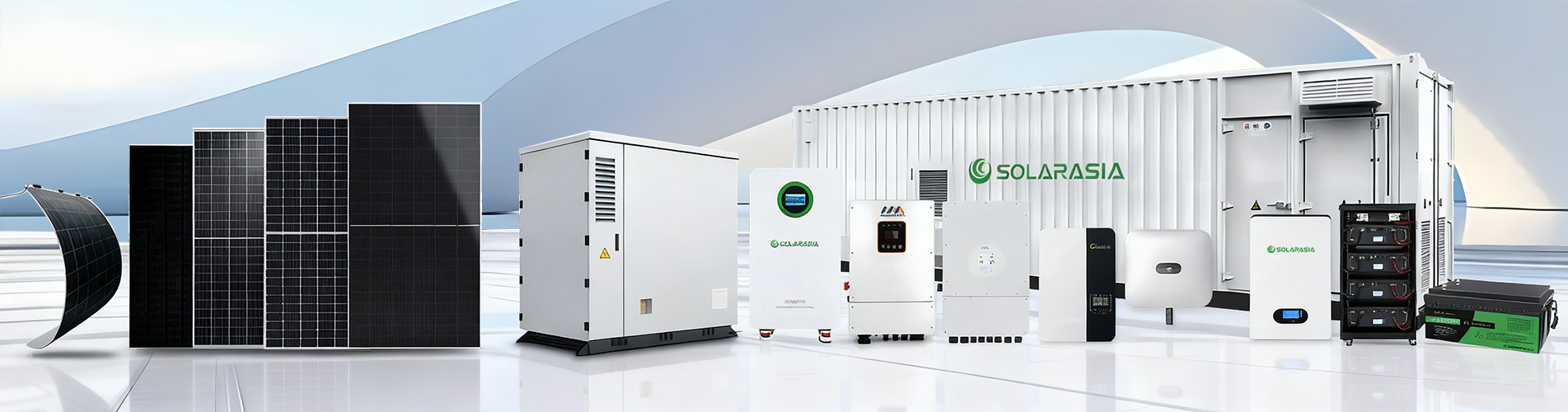
How to Request a Commercial BESS Quotation: 12 Key Project Details Suppliers Need
Planning to purchase a commercial battery energy storage system (BESS)? Before contacting manufacturers or suppliers, preparing the right project information can make the quotation process faster, more accurate, and more efficient.
A commercial BESS quotation involves more than the price of battery cabinets. The final system configuration may include battery modules, a power conversion system (PCS), an energy management system (EMS), thermal management, fire protection, electrical equipment, installation support, and other customized components.
Without sufficient project details, suppliers may only be able to provide an estimated price rather than a technically suitable solution.
Whether you are planning a factory energy storage project, a commercial solar-plus-storage installation, or an industrial backup power system, this guide explains the 12 key details you should prepare before requesting a commercial BESS quotation.
The first step is to identify what you want the battery energy storage system to achieve.
Different applications require different system configurations, power ratings, energy capacities, and control strategies.
Common commercial and industrial BESS applications include:
Peak Shaving
The battery discharges during periods of high electricity demand to reduce the power drawn from the grid. This may help reduce demand-related electricity charges where the local tariff structure supports it.
Time-of-Use Energy Management
The system charges during lower-price electricity periods and discharges during higher-price periods, depending on the electricity tariff and system operating strategy.
Solar Self-Consumption
A battery stores available surplus solar energy and supplies it later when solar generation is insufficient.
Backup Power
A properly configured BESS can supply selected critical loads during grid outages. This requires appropriate backup or islanding capabilities and compatible electrical equipment.
Microgrid Applications
Battery storage can work with solar PV, generators, and other energy sources to support a coordinated microgrid, subject to the system architecture and control capabilities.
Before requesting a quotation, specify your main application and whether you need one function or several combined functions.
Power rating is one of the most important parameters in a commercial BESS project.
It determines how much electrical power the system can deliver or absorb at a given moment.
For example:
50 kW: Suitable for certain smaller commercial applications.
100 kW: A common power class for commercial and industrial projects.
125 kW: Used in some higher-power commercial configurations.
250 kW and above: May be considered for larger industrial applications.
These are example power classes, not recommendations for a particular project.
When requesting a quotation, provide:
Maximum facility demand
Target peak demand reduction
Required charging power
Required discharging power
Critical load power, if backup is required
The supplier can use this information to evaluate the required PCS rating and battery configuration.
Remember that kW and kWh describe different things. Power determines how quickly energy can be delivered, while energy capacity determines how much energy can be stored.
Battery capacity determines how much energy the BESS can store.
It is generally measured in kilowatt-hours (kWh) or megawatt-hours (MWh).
For example, a commercial energy storage system may have a nominal capacity of 100 kWh, 215 kWh, 261 kWh, or a larger customized configuration.
To estimate the required capacity, suppliers need to understand:
How much energy the system should deliver
How many hours the battery should discharge
Required usable battery capacity
Maximum depth of discharge (DoD)
Battery charging and discharging efficiency
Operating SOC limits
A simplified calculation is:
Required nominal battery capacity = Required AC energy output ÷ (Usable DoD × Discharge efficiency)
For example, assume a project needs 200 kWh of AC energy output, with an assumed usable DoD of 90% and discharge efficiency of 95%.
Required nominal capacity:
200 ÷ (0.90 × 0.95) ≈ 234 kWh
This is an illustrative calculation. Actual sizing should consider the battery manufacturer's specifications, operating conditions, system losses, reserve requirements, and degradation allowance.
Providing the required discharge duration is also important. A system designed to deliver power for one hour may require a different battery capacity from one designed for four hours, even if both have the same PCS rating.
A historical electricity load profile is one of the most useful documents for commercial BESS sizing.
It shows how electricity consumption changes throughout the day, helping suppliers understand when the facility needs power and when the battery can charge.
Useful information includes:
Daily electricity consumption
Monthly electricity consumption
Maximum demand
Average demand
Peak demand periods
Operating hours
Weekend and seasonal load variations
If available, provide 15-minute or 30-minute interval electricity consumption data.
A typical electricity bill may provide monthly consumption and maximum demand, but interval data gives suppliers a much clearer understanding of actual load behavior.
For example, a manufacturing plant may experience high electricity demand when several production lines start simultaneously. A BESS designed for this application should be evaluated against the actual load profile rather than monthly electricity consumption alone.
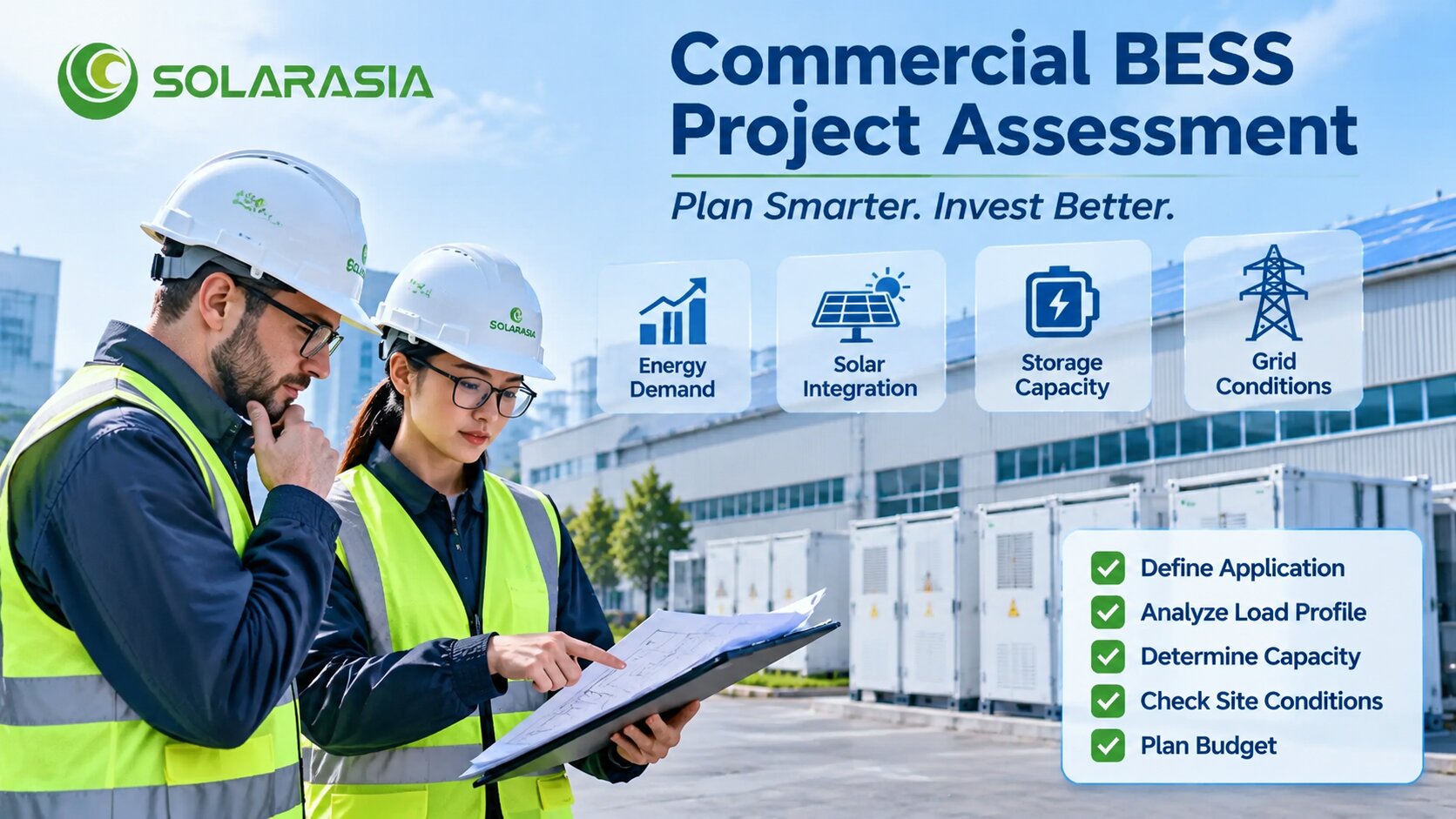
If your project includes solar power, provide the existing or planned PV system information.
Important details include:
Total installed solar capacity (kWp)
Solar inverter rated power (kW)
Inverter brand and model
Existing AC or DC system architecture
Daily solar generation, if available
Electricity exported to the grid
Solar energy consumed on-site
Planned solar expansion
This information helps suppliers determine how the battery storage system can be integrated with the solar installation.
Two common configurations are AC-coupled and DC-coupled BESS.
AC-coupled systems are often considered for retrofitting battery storage into existing solar installations. DC-coupled systems may be suitable for projects designed around compatible solar and storage equipment from the beginning.
The appropriate solution depends on the existing inverter, electrical infrastructure, battery system, and project requirements.
Grid connection conditions can significantly affect commercial BESS system design.
Before requesting a quotation, provide the following information where available:
Grid voltage
Grid frequency
Single-phase or three-phase connection
Transformer capacity
Main switchgear rating
Existing electrical distribution configuration
Grid connection restrictions
Export limitations
Local interconnection requirements
For larger projects, suppliers may also need information about transformer impedance, short-circuit levels, grounding arrangements, power factor requirements, and grid protection settings.
Do not assume that every commercial BESS can connect directly to an existing electrical panel. The system may require additional switchgear, transformers, protection devices, or electrical engineering work.
Local grid codes and utility approval requirements should be confirmed before final system selection.
Not every commercial battery storage project requires backup power.
Some projects are designed only for peak shaving or electricity cost management, while others need to maintain selected operations during a grid outage.
If backup power is required, provide:
Critical load capacity (kW)
Required backup duration
Types of connected equipment
Starting current of motors or compressors
Required transfer time
Whether the entire facility or selected circuits need backup
For example, a cold storage facility may prioritize refrigeration equipment, monitoring systems, and essential ventilation rather than supplying the entire facility.
Backup operation requires a compatible system architecture. The PCS may need grid-forming or backup capabilities, together with suitable isolation, transfer, and protection equipment.
Suppliers should confirm these functions explicitly in the technical proposal.
The installation environment affects battery performance, equipment selection, and system protection requirements.
Suppliers need to know where the BESS will be installed.
Relevant details include:
Indoor or outdoor installation
Ambient temperature range
Relative humidity
Rain and water exposure
Dust and corrosive conditions
Altitude
Available installation space
Ventilation and access requirements
For outdoor installations, buyers should also confirm the required enclosure protection rating.
For example, an IP rating describes protection against the ingress of solid objects and water under specified test conditions. It should not be treated as a complete guarantee of suitability for every outdoor environment.
Battery operating temperatures and charging limits must follow the manufacturer's specifications. Special attention is required for projects in very hot or cold climates.
Battery chemistry affects energy density, cycle-life characteristics, thermal behavior, operating conditions, and system design.
Lithium iron phosphate (LiFePO4 or LFP) is widely used in commercial and industrial energy storage applications.
When requesting a quotation, clarify whether you have a preferred battery technology or specific requirements for:
Battery chemistry
Cell manufacturer
Cell capacity
Nominal voltage
Cycle-life conditions
Usable energy
Operating temperature range
Warranty terms
If you do not have a specific preference, ask the supplier to recommend a suitable battery configuration based on the project requirements.
Do not compare battery products based on cycle-life numbers alone. Cycle-life claims should be reviewed together with the test conditions, depth of discharge, temperature, charge and discharge rates, and end-of-life criteria.
The EMS manages how the battery storage system operates.
Different projects may require different control functions and monitoring capabilities.
Before requesting a quotation, consider whether you need:
Remote system monitoring
Real-time power and energy data
Peak demand control
Time-of-use charging and discharging
Solar generation coordination
Battery SOC monitoring
Historical data and performance reports
Alarm notifications
Third-party monitoring integration
If your project requires communication with existing industrial control systems, provide the required communication protocols and integration details.
For example, Modbus RTU or Modbus TCP may be used in some energy storage applications, but protocol support alone does not guarantee complete compatibility. Register maps, communication interfaces, control permissions, and device-specific integration should be confirmed.
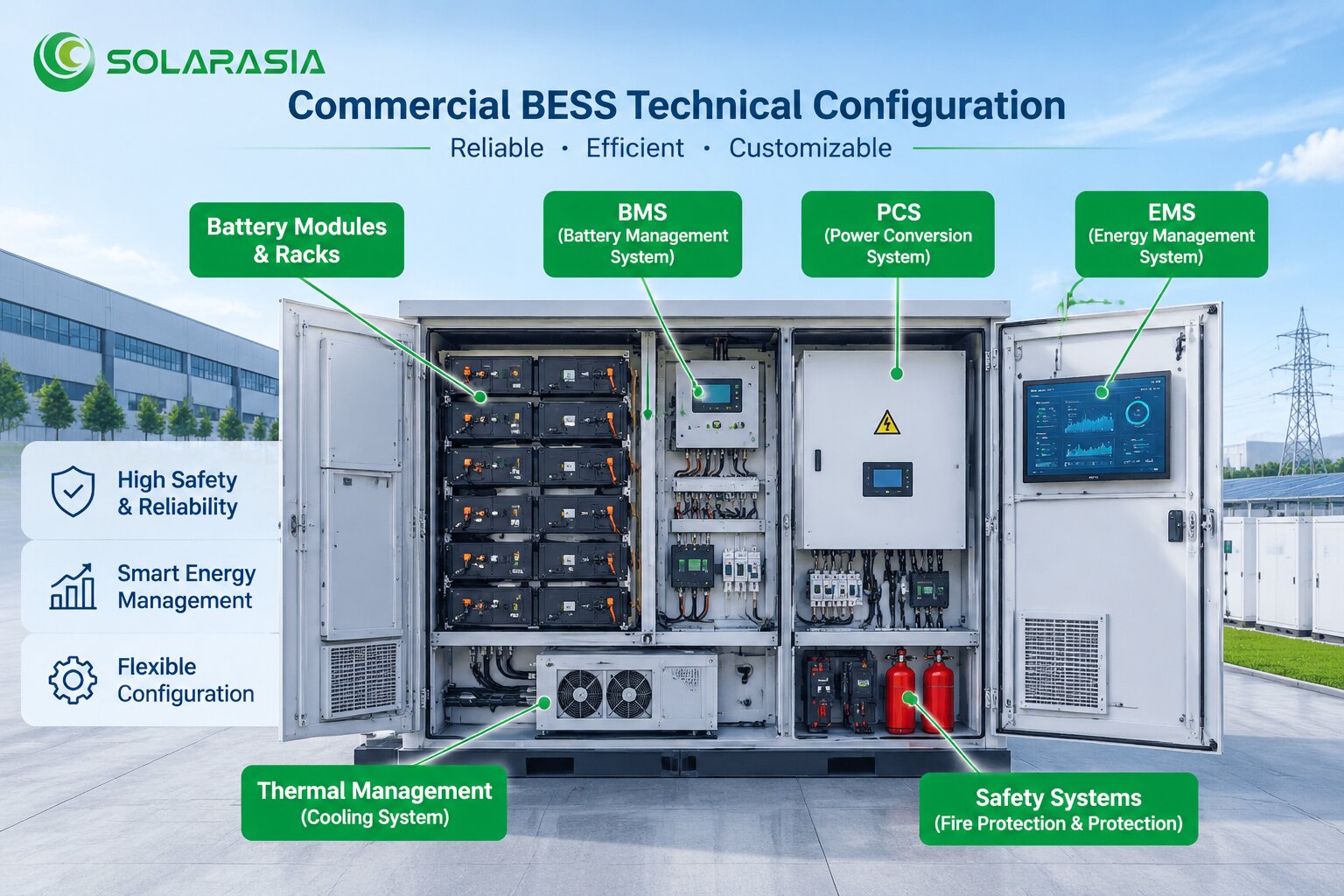
Safety and compliance requirements should be discussed before the final quotation.
Depending on the destination market and project type, buyers may need to verify specific product and system certifications, electrical standards, fire protection requirements, and grid connection approvals.
Relevant considerations may include:
Battery safety documentation
BMS protection functions
Thermal management
Fire detection and suppression design
Electrical protection
Enclosure protection rating
Transportation documentation
Applicable local installation regulations
Requirements vary between countries and markets. A certificate for an individual battery cell does not automatically mean that the complete energy storage system has the same certification.
Ask the supplier to provide the actual certificates and technical documents applicable to the proposed product configuration.
The final quotation should clearly explain the commercial scope, not just the equipment price.
Before requesting a quote, specify:
Project country and delivery address
Required delivery schedule
Preferred shipping terms
Whether installation is included
Whether commissioning support is required
Warranty expectations
Spare parts requirements
Technical training requirements
After-sales service expectations
A quotation may include only battery cabinets, or it may cover a more complete solution with PCS, EMS, electrical equipment, engineering, commissioning, and technical support.
Make sure you understand exactly what is included and excluded.
For a fair supplier comparison, request an itemized quotation that separates major equipment, optional accessories, engineering services, transportation, installation, and other project costs.
Use the following checklist to prepare your project information before contacting suppliers.
| Project Information | Details to Prepare |
|---|---|
| Application | Peak shaving, solar storage, backup power, or other |
| Required Power | kW |
| Required Energy | kWh or MWh |
| Discharge Duration | Hours |
| Load Profile | 15-minute or 30-minute interval data, if available |
| Electricity Consumption | Monthly or annual kWh |
| Solar PV Capacity | kWp |
| Solar Inverter | Brand and model |
| Grid Conditions | Voltage and frequency |
| Backup Requirement | Critical load and duration |
| Installation Environment | Indoor or outdoor |
| Battery Technology | LFP or other preferred chemistry |
| EMS Requirements | Monitoring and control functions |
| Compliance | Destination market and applicable requirements |
| Delivery | Destination, schedule, and shipping terms |
You do not need to have every detail ready before contacting a supplier. However, providing more project information generally makes it easier to evaluate system feasibility and prepare a suitable preliminary quotation.
Choosing a commercial battery energy storage supplier is an important decision because the quality of the system design can affect long-term performance, safety, and project economics.
When evaluating potential manufacturers, consider the following:
Manufacturing Capability: Check whether the supplier has its own production facilities, quality control procedures, and product testing capabilities.
Technical Support: A qualified supplier should be able to evaluate project requirements and recommend suitable power and energy configurations.
Product Customization: Different projects may require different battery capacities, PCS ratings, enclosure designs, and EMS functions.
Documentation and Compliance: Review product datasheets, installation manuals, test reports, and applicable certificates.
Warranty and After-Sales Service: Understand warranty conditions, technical support arrangements, and replacement procedures.
Project Experience: Ask about relevant commercial and industrial energy storage applications.
An experienced manufacturer should be able to explain not only the product specifications but also how the proposed system matches your actual project requirements.
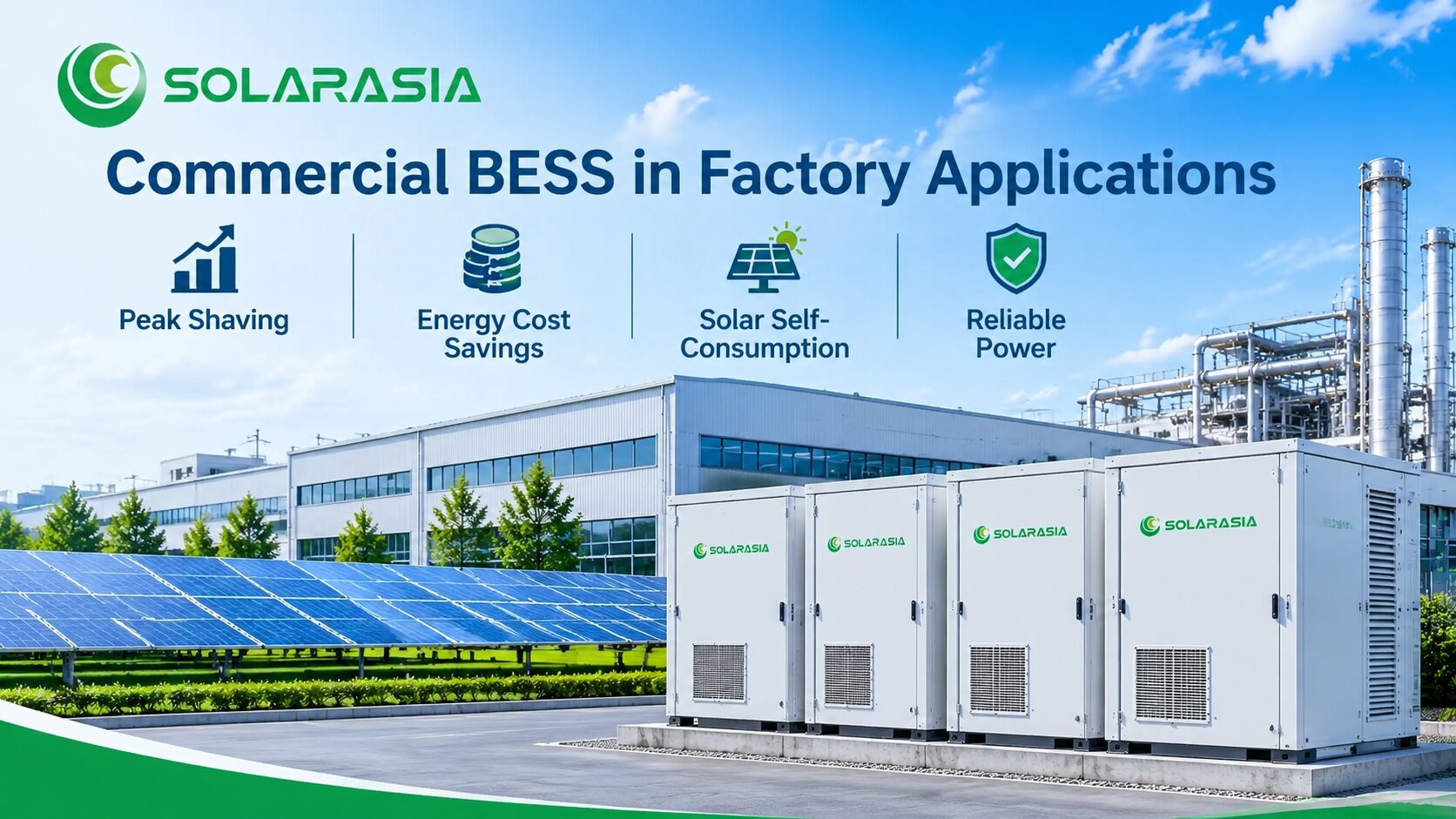
At SOLARASIA, we provide commercial and industrial battery energy storage solutions for factories, warehouses, commercial buildings, solar projects, and other energy storage applications.
We understand that every project has different power requirements, electricity consumption patterns, installation environments, and operating objectives.
Our team can help evaluate your project information and discuss suitable battery capacity, PCS power, system configuration, and customization options.
To help us prepare a preliminary quotation, send us the following information:
Project application
Required power (kW)
Required energy capacity (kWh)
Expected discharge duration
Project country
Existing solar PV capacity, if applicable
Backup power requirements, if applicable
Even if you do not have a complete technical specification, you can share your electricity bills, load profile, or basic project description with our team.
Looking for a reliable commercial BESS manufacturer?
Contact SOLARASIA to discuss your project and request a customized commercial battery energy storage solution.
Explore our Commercial and Industrial Battery Energy Storage Systems for more information.
The most important information includes the required power in kW, battery capacity in kWh, main application, discharge duration, electricity load profile, grid conditions, installation environment, and project location.
Yes. You can provide your electricity bills, peak demand, operating schedule, and application requirements. A qualified supplier can use this information to help estimate the required power and energy capacity.
kW refers to the power the system can deliver or absorb, while kWh refers to the amount of energy stored in the battery. Both parameters are necessary for selecting a suitable commercial BESS.
The time depends on project complexity and the completeness of the technical information. A preliminary quotation may be prepared using basic project details, while a detailed engineering proposal may require additional load data, electrical drawings, and site information.
Not necessarily. Some quotations cover equipment supply only, while others may include engineering, installation guidance, commissioning, and technical services. Always confirm the scope of supply.
Yes. Depending on manufacturer capabilities, a commercial BESS can be configured according to required battery capacity, PCS power, cooling method, enclosure design, EMS functions, and project application.
This depends on your solar PV configuration and electrical infrastructure. AC-coupled systems are often considered for existing solar installations, while DC-coupled systems may suit compatible new solar-plus-storage projects.
Compare the usable battery capacity, PCS power, battery technology, system efficiency conditions, operating temperature range, safety features, certifications, warranty, EMS functions, scope of supply, and after-sales support. Avoid comparing suppliers based on total price alone.


Adresse : Room 908-909, Building 2, No. 469 Huatuo Lane, Shushan District, Hefei City, Anhui Province


Continuez à lire, restez informé, abonnez-vous et nous vous invitons à nous dire ce que vous en pensez.
Links: Inverter Cables
Sunrangeenergy
gmsolarkit
droits d'auteur
2026 @ Anhui Solarasia Energy Technology Co., Ltd .Tous les droits sont réservés
. Plan du site
| Blog
| XML | politique de confidentialité
 RÉSEAU PRIS EN CHARGE
