


Commercial BESS Round-Trip Efficiency: What Buyers Need to Know
When evaluating a commercial battery energy storage system (BESS), buyers often focus on battery capacity, rated power, cycle life, and equipment price. However, another important technical parameter deserves attention: round-trip efficiency (RTE).
Round-trip efficiency measures how much electrical energy can be recovered from a battery energy storage system compared with the amount of energy used to charge it.
For commercial and industrial facilities, BESS efficiency directly affects how much stored electricity can actually be used, how much energy is lost during operation, and how the system performs economically over time.
But what is a good round-trip efficiency? How is it calculated? Which components contribute to energy losses? And how should buyers compare efficiency data from different BESS suppliers?
This guide explains the key factors behind commercial battery energy storage efficiency and provides practical advice for evaluating BESS performance.
Round-trip efficiency is the ratio between the energy discharged from a battery energy storage system and the energy supplied to charge it, measured over a defined operating cycle.
It is usually expressed as a percentage.
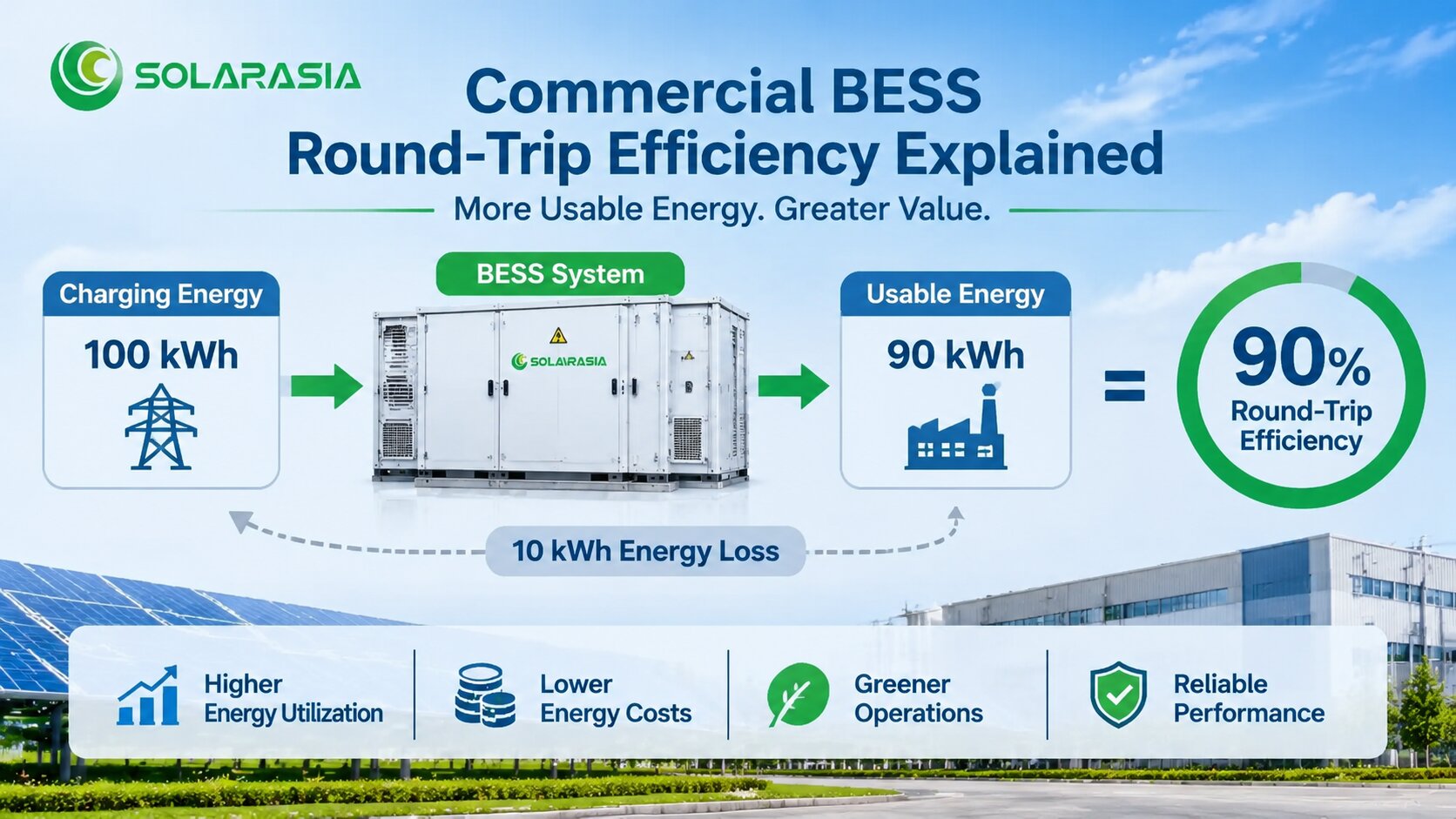
For example, if a BESS receives 100 kWh of charging energy and later delivers 90 kWh of usable energy, its round-trip efficiency is:
90 kWh ÷ 100 kWh × 100% = 90%
This means that 10 kWh of energy was lost during the charging, storage, and discharging process under the assumed measurement conditions.
In practical applications, energy losses may occur in several parts of the system, including:
Battery cells and internal resistance
Battery management and control equipment
Power conversion system (PCS)
Transformers and electrical connections
Cooling and auxiliary equipment
Other system components
It is important to understand that round-trip efficiency is not necessarily the same as battery cell efficiency. A complete BESS includes multiple components, and the overall system performance depends on how they work together.
The basic formula is:
Round-Trip Efficiency = Discharged Energy ÷ Charged Energy × 100%
For a commercial BESS, the measurement boundary must also be clearly defined.
For example, efficiency may be measured at the battery DC terminals or at the system AC connection point.
These measurements are not directly interchangeable because AC-side measurements may include PCS conversion losses and other electrical losses that are not included in a battery-only DC measurement.
Consider a commercial battery energy storage system with the following illustrative operating data:
| Parameter | Example Value |
|---|---|
| Charging Energy | 100 kWh |
| Discharged Energy | 90 kWh |
| Energy Loss | 10 kWh |
| Round-Trip Efficiency | 90% |
Calculation:
90 ÷ 100 × 100% = 90%
In this example, the system delivers 90 kWh after receiving 100 kWh of charging energy.
The remaining 10 kWh represents energy losses within the defined measurement boundary.
Suppose one supplier reports battery DC round-trip efficiency while another reports complete system AC round-trip efficiency.
Even if both suppliers use accurate test data, their reported percentages may differ because they measure different parts of the system.
Before comparing BESS efficiency figures, confirm:
Whether measurements are AC-side or DC-side
Whether auxiliary electricity consumption is included
Whether transformer losses are included
Whether the same charging and discharging conditions are used
Whether the figures represent tested or calculated performance
A clearly defined measurement method is essential for a meaningful comparison.
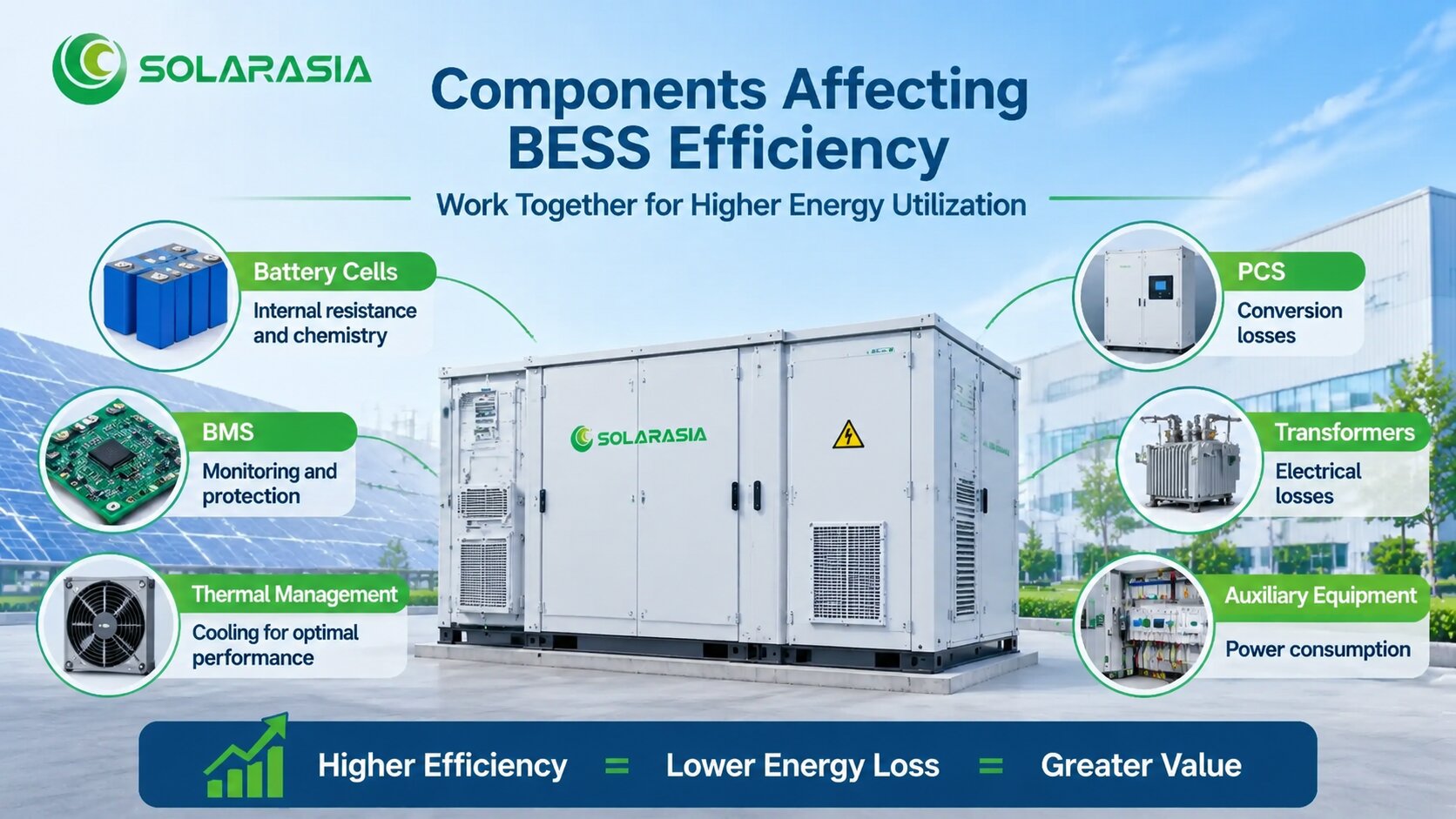
A commercial battery energy storage system contains several components that contribute to overall energy losses.
Battery cells store and release energy through electrochemical reactions.
Some energy is lost during charging and discharging because of internal resistance and other electrochemical processes.
Battery performance can vary according to:
Battery chemistry
Cell design and quality
Charging and discharging current
Operating temperature
State of charge (SOC)
Battery aging
LiFePO4 batteries are widely used in commercial and industrial energy storage. However, battery chemistry alone does not determine the round-trip efficiency of the complete system.
The PCS converts electricity between AC and DC.
In a typical AC-coupled BESS:
During charging, AC electricity is converted into DC electricity.
During discharging, DC electricity is converted into AC electricity.
Energy is lost during both conversion processes.
PCS efficiency can vary depending on operating power, voltage, temperature, and equipment design.
For this reason, buyers should review PCS efficiency curves where available rather than relying only on a single maximum efficiency figure.
The BMS monitors battery voltage, current, temperature, SOC, and other operating parameters.
Although the BMS is primarily designed for monitoring and battery protection, it also consumes a certain amount of electricity.
Its power consumption is generally part of the system's auxiliary energy requirements when included within the measurement boundary.
Commercial BESS installations may use air cooling or liquid cooling to maintain battery operating temperatures.
Cooling equipment consumes electricity during operation.
The amount of energy required depends on:
Ambient temperature
Battery operating temperature
System loading
Cooling system design
Operating schedule
In hot environments, cooling equipment may consume more energy. This is one reason why auxiliary electricity consumption should be considered when evaluating complete system efficiency.
Some commercial BESS configurations include transformers, switchgear, cables, and additional electrical equipment.
These components may introduce electrical losses.
For an AC-side system efficiency calculation, the measurement point determines whether such losses are included.
Buyers should ask suppliers to explain the efficiency calculation boundary and identify which equipment is covered.
One of the most important points when comparing commercial BESS products is the difference between AC-side and DC-side efficiency.
DC round-trip efficiency generally measures energy entering and leaving the battery system on the DC side.
Depending on the measurement boundary, it may include battery-related losses and some DC-side equipment losses.
It may exclude PCS conversion losses and other AC-side losses.
AC round-trip efficiency measures the energy delivered from the BESS at an AC connection point compared with the energy supplied at that point during charging.
Depending on the defined boundary, it can include:
PCS charging and discharging losses
Battery losses
Auxiliary power consumption
Transformer and other electrical losses
| Comparison | DC Round-Trip Efficiency | AC Round-Trip Efficiency |
|---|---|---|
| Measurement Side | DC | AC |
| Battery Losses | Included within the defined boundary | Included within the defined boundary |
| PCS Conversion Losses | May be excluded | Usually included when PCS is inside the boundary |
| Auxiliary Consumption | Depends on measurement setup | Depends on measurement setup |
| Transformer Losses | Usually excluded if outside boundary | Included if inside boundary |
| Main Evaluation Purpose | Battery or DC subsystem performance | Complete system energy performance at the AC boundary |
For most commercial energy users evaluating electricity delivered to facility loads, AC-side system efficiency is particularly relevant.
However, buyers should always check the exact test method and measurement boundary before making comparisons.
There is no single efficiency figure that is appropriate for every commercial battery energy storage system.
The reported value depends on system architecture, battery chemistry, PCS design, operating conditions, auxiliary loads, and measurement boundaries.
A supplier may provide different figures for:
Battery cell efficiency
Battery DC system efficiency
PCS conversion efficiency
Complete BESS AC round-trip efficiency
These values describe different performance levels and should not be compared as if they were equivalent.
When evaluating a commercial BESS, ask suppliers to provide:
Rated or guaranteed system efficiency
AC-side or DC-side measurement definition
Charging and discharging power conditions
Operating SOC range
Ambient and battery temperature conditions
Auxiliary consumption assumptions
Test report or supporting technical documentation
A slightly higher advertised efficiency does not automatically mean a better investment. The actual system configuration, warranty, operating profile, equipment quality, and total project cost also matter.
Commercial BESS efficiency is not necessarily constant under every operating condition.
Several factors can influence the amount of energy recovered after charging.
PCS and battery efficiency can change depending on operating power.
A system operating at different charging or discharging power levels may experience different conversion losses.
Therefore, buyers should review efficiency information at operating points relevant to their project rather than considering only maximum-rated performance.
SOC represents the remaining charge level of the battery relative to its defined capacity.
The selected operating SOC range can influence battery performance and available energy.
For example, a system operating between 10% and 90% SOC has a different usable energy range from one operating between 5% and 95% SOC.
A wider SOC range does not automatically mean better overall project performance. Operating limits should follow manufacturer specifications and the intended battery life strategy.
Temperature affects battery electrochemical behavior and the operation of cooling equipment.
Very high or low temperatures may influence charging and discharging performance.
For projects in hot climates, the cooling system may require additional energy to maintain suitable battery operating conditions.
For cold environments, battery charging and discharging limits may need to be adjusted according to manufacturer requirements.
Battery capacity and internal resistance can change over time.
As a battery ages, its available energy capacity and power characteristics may change.
This can affect the amount of energy that can be delivered during a particular operating cycle.
Buyers should therefore evaluate both initial efficiency and long-term performance expectations.
A commercial BESS may use electricity for:
Cooling fans or liquid cooling pumps
Control systems
Monitoring equipment
Communication devices
Other auxiliary loads
If these loads are excluded from a supplier's efficiency calculation, the reported efficiency may not represent the energy actually available to the facility.
For projects with continuous operation or significant thermal management requirements, auxiliary energy consumption deserves particular attention.
Round-trip efficiency affects how much electricity a business can recover from the energy used to charge its battery.
A lower efficiency means more charging energy is required to deliver the same amount of electricity.
Consider a simplified example.
A factory wants to receive 90 kWh of usable AC electricity from its BESS.
Assume two hypothetical system efficiencies:
| Parameter | System A | System B |
|---|---|---|
| Round-Trip Efficiency | 90% | 95% |
| Required Delivered Energy | 90 kWh | 90 kWh |
| Required Charging Energy | 100 kWh | 94.74 kWh |
| Energy Loss | 10 kWh | 4.74 kWh |
Calculation:
System A: 90 ÷ 0.90 = 100 kWh
System B: 90 ÷ 0.95 ≈ 94.74 kWh
Under these assumptions, System B requires approximately 5.26 kWh less charging energy to deliver the same 90 kWh.
If the charging electricity price is $0.10 per kWh, the illustrative energy cost difference per cycle is:
5.26 × $0.10 = $0.526
This is a simplified comparison, not a project savings guarantee.
Actual financial performance depends on electricity tariffs, operating cycles, system availability, battery degradation, auxiliary consumption, and the specific efficiency measurement boundary.
For a complete investment evaluation, efficiency should be considered together with peak shaving benefits, energy arbitrage opportunities, demand charges, and project operating costs.
When comparing commercial BESS suppliers, do not rely on a single percentage displayed in a product brochure.
Request detailed technical information so that you can compare products under equivalent conditions.
1. Is the quoted efficiency AC-side or DC-side?
Confirm the measurement boundary and the equipment included.
2. Does the figure include auxiliary consumption?
Ask whether cooling, control, and monitoring power consumption are included.
3. Under what operating conditions was it measured?
Review charging and discharging power, SOC range, and temperature.
4. Is the figure a maximum value or a guaranteed value?
Maximum efficiency may only be achieved under specific operating conditions.
5. Is supporting test documentation available?
Request relevant test reports or technical documentation for the proposed system.
6. How does efficiency change with operating power?
Ask for efficiency curves or additional operating-point data where available.
7. What happens as the battery ages?
Discuss capacity retention, warranty conditions, and long-term performance assumptions.
| Evaluation Item | What Buyers Should Check |
|---|---|
| Round-Trip Efficiency | AC-side or DC-side |
| Measurement Boundary | Included and excluded components |
| PCS Efficiency | Charging and discharging performance |
| Battery Operating Range | SOC limits |
| Auxiliary Consumption | Cooling and control loads |
| Operating Conditions | Power and temperature |
| Test Documentation | Test reports and technical datasheets |
| Warranty | Capacity retention and operating conditions |
| Long-Term Performance | Degradation assumptions |
A supplier that provides clear efficiency definitions and supporting documentation makes it easier to evaluate the proposed system accurately.
Although some energy losses are unavoidable, proper system selection and operation can help reduce unnecessary losses.
The PCS should match the required charging and discharging power.
An unsuitable power rating may result in inefficient operation or insufficient power capability.
Battery capacity should be based on actual energy demand and operating objectives.
Oversizing or undersizing a battery system without a clear project reason can affect investment efficiency.
The EMS should coordinate battery operation with electricity tariffs, load profiles, and solar generation.
A suitable operating strategy can improve the economic value of the stored energy.
Follow manufacturer temperature requirements and ensure that thermal management equipment operates correctly.
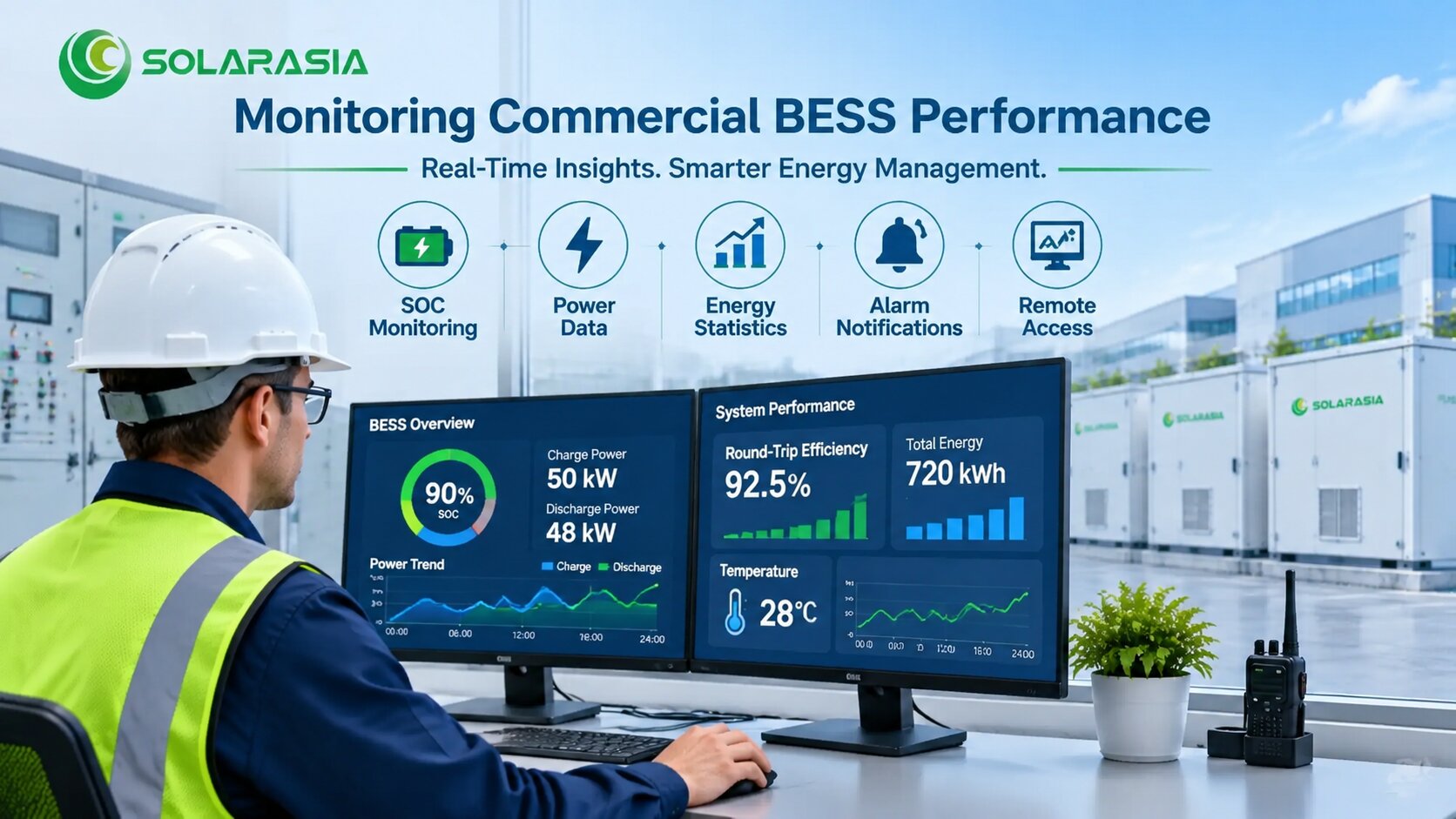
Regularly review:
Charging energy
Discharged energy
SOC
Battery temperature
PCS operating status
Auxiliary electricity consumption
System alarms
Monitoring actual operating data helps identify unexpected energy losses and operational issues.
Round-trip efficiency is important, but it should not be the only factor used to select a commercial battery energy storage system.
A complete BESS evaluation should also consider:
Battery capacity and usable energy
PCS rated power
Battery chemistry
Cycle-life conditions
System safety design
Thermal management
EMS functions
Applicable certifications
Warranty coverage
Installation requirements
Supplier technical support
For example, a system with a higher advertised efficiency may not be the most suitable option if its power rating, battery capacity, or operating temperature range does not match the project.
The best solution is one that balances technical performance, safety, operating requirements, and total project economics.
Understanding commercial BESS round-trip efficiency helps buyers make more informed decisions when comparing battery storage systems.
However, the efficiency of a complete energy storage system depends on more than battery cells. PCS conversion, auxiliary equipment, thermal management, system architecture, and operating conditions all influence actual energy performance.
At SOLARASIA, we provide commercial and industrial battery energy storage solutions for different project requirements, including factory energy management, solar-plus-storage applications, and commercial battery storage projects.
Our team can help discuss battery capacity, PCS power, system configuration, and technical requirements based on your application.
Planning a commercial battery storage project?
Contact SOLARASIA to discuss your requirements and request a customized BESS solution.
To help us evaluate your project, please share:
Required power (kW)
Required battery capacity (kWh)
Main application
Expected charging and discharging schedule
Project location
Existing solar PV configuration, if applicable
Explore our Commercial and Industrial Battery Energy Storage Solutions to learn more.
Round-trip efficiency is the ratio of energy discharged from a battery energy storage system to the energy supplied during charging, expressed as a percentage. It indicates how much energy can be recovered after a charging and discharging cycle.
Divide the discharged energy by the charging energy and multiply the result by 100%. For example, if a system receives 100 kWh and delivers 90 kWh, its round-trip efficiency is 90% under the defined measurement conditions.
DC round-trip efficiency measures energy at the DC side of the system, while AC round-trip efficiency measures energy at an AC connection point. AC-side measurements may include PCS conversion losses and other equipment losses depending on the measurement boundary.
Yes. The PCS converts AC electricity into DC electricity during charging and DC electricity into AC electricity during discharging. Conversion losses contribute to overall system energy losses when the PCS is included within the measurement boundary.
Yes. Battery temperature can influence electrochemical performance, while cooling equipment also consumes electricity. Both factors may affect the overall energy efficiency of a commercial BESS.
Battery aging can change internal resistance and available capacity, which may influence operating performance over time. The actual impact depends on battery design, usage, temperature, and operating conditions.
Higher efficiency can reduce energy losses, but it should not be the only purchasing criterion. Buyers should also consider usable capacity, power rating, safety, warranty, operating conditions, and total project economics.
Ask for the AC or DC efficiency definition, measurement boundary, operating power, SOC range, temperature conditions, auxiliary consumption assumptions, test documentation, and relevant warranty terms.


Adresse : Room 908-909, Building 2, No. 469 Huatuo Lane, Shushan District, Hefei City, Anhui Province


Continuez à lire, restez informé, abonnez-vous et nous vous invitons à nous dire ce que vous en pensez.
Links: Inverter Cables
Sunrangeenergy
gmsolarkit
droits d'auteur
2026 @ Anhui Solarasia Energy Technology Co., Ltd .Tous les droits sont réservés
. Plan du site
| Blog
| XML | politique de confidentialité
 RÉSEAU PRIS EN CHARGE
